Physical quantities
Physical quantities are properties of objects or phenomena that can be measured. Every physical quantity consists of two parts:
- A numerical magnitude (how much)
- A unit (what it is measured in)
For example, if you measure the length of a table to be 1.5 metres, "1.5" is the numerical magnitude and "metres" (m) is the unit.
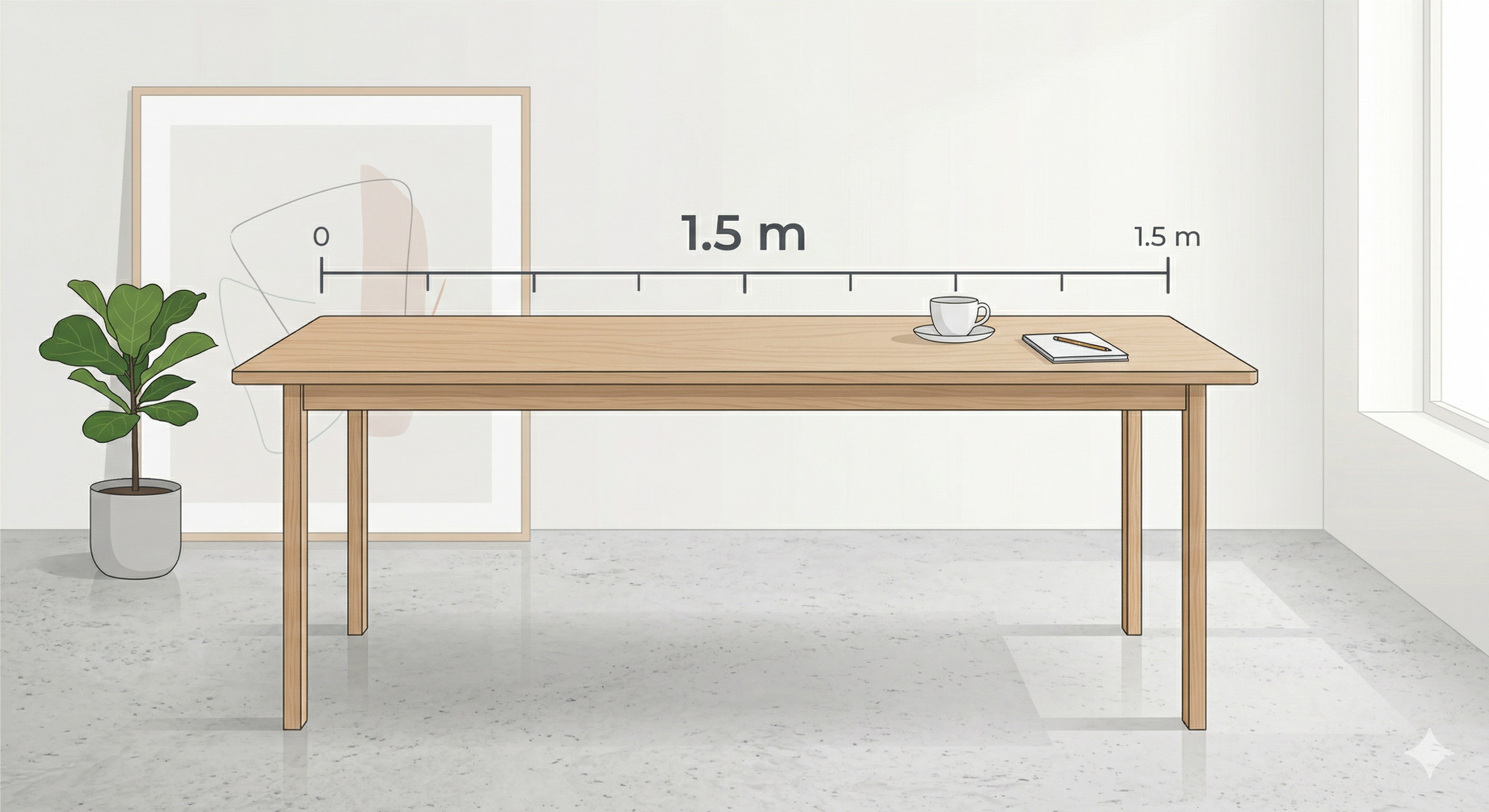
A physical quantity is a property of a material or system that can be quantified by measurement and expressed as the product of a numerical value and a unit.
Physical quantities can be classified as either scalar or vector:
- Scalar quantities have only magnitude (e.g. mass, temperature, energy)
- Vector quantities have both magnitude and direction (e.g. velocity, force, displacement)
Always include units with every physical quantity.
Making reasonable estimates
In physics, it is important to be able to estimate the values of common physical quantities. This helps you check if your answers are sensible.
Some typical estimates:
- Mass of a textbook: about 1 kg
- Height of a door: about 2 m
- Speed of a walking person: about 1.5 m/s
- Volume of a cup: about 250 cm³ (0.25 L)
- The mass of a textbook: about 1 kg
- The height of a door: about 2 m
When making estimates, use your everyday experience and round to the nearest sensible value.
Summary
- All physical quantities have a magnitude and a unit.
- Scalars have magnitude only; vectors have magnitude and direction.
- Being able to estimate physical quantities is a key skill in physics.
Show all working in calculations, even if the answer seems obvious.
Navigation


Website designed & developed with 🖤 by Vasumitra
Website designed & developed with 🖤
by Vasumitra
© 2025 r/alevel • All Rights Reserved